


Hello hello! It’s Dan Frommer, back with The New Consumer. How are you?
One quick plug: I was back on the This Is Taste podcast this week, live-snacking in studio with Matt Rodbard. (Instagram highlights Reel here.) We talked about our favorites from the Fancy Food show — Mr. Pickles, Ginja Snap, The Great Chestnut Experiment, etc. — and a few points from my new Consumer Trends report with Coefficient Capital.
I’ll be off next week for vacation, then back in the US for a while in July and August. What’s good in LA these days?
Presented by Aboard

You built your product and brand from scratch. You’d never sell someone else’s stuff with your name on it. But that’s exactly what you’ve been doing with your internal tools — running your business on software that was built for everyone and no one. That doesn’t have to be the deal anymore.
The math has changed. The cost and speed of building custom software have dropped so dramatically that it’s now a real option for consumer brands, not just giant companies with engineering departments.
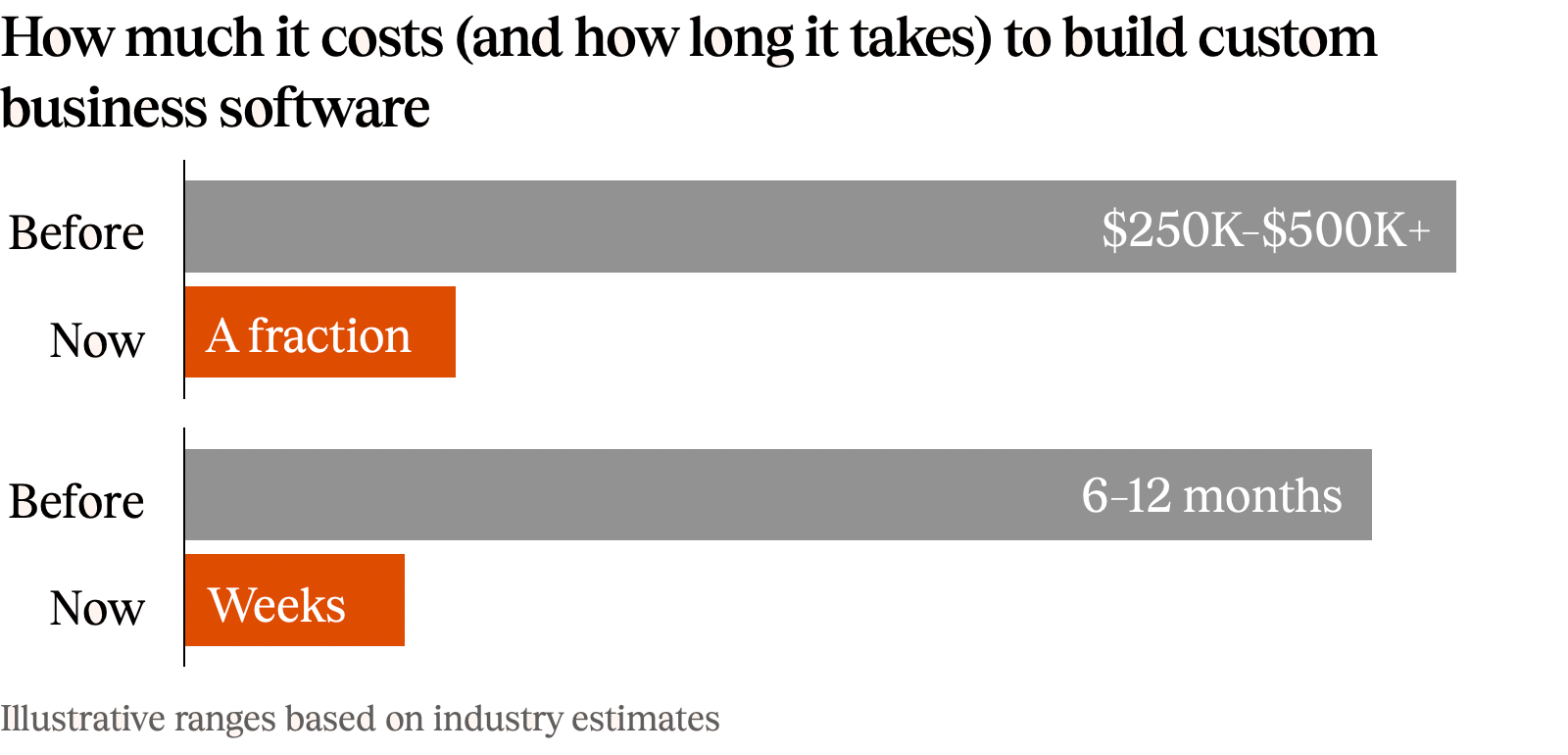
Think about what you’d build if you could: The operational tool that doesn’t exist yet. The dashboard that would actually show you what matters. The workflow your team currently runs on spreadsheets and inertia. You can probably have it now — built around how your company actually works, in weeks instead of months.
Aboard is a software studio led by experienced builders who’ve shipped for some of the world’s biggest companies. We use modern tools and AI to move fast, but every project is led by senior engineers and designers who ensure the software is secure, professionally built, and actually works. Custom business tools, at a speed and price that would’ve been unthinkable a few years ago.
See what Aboard can build for you →
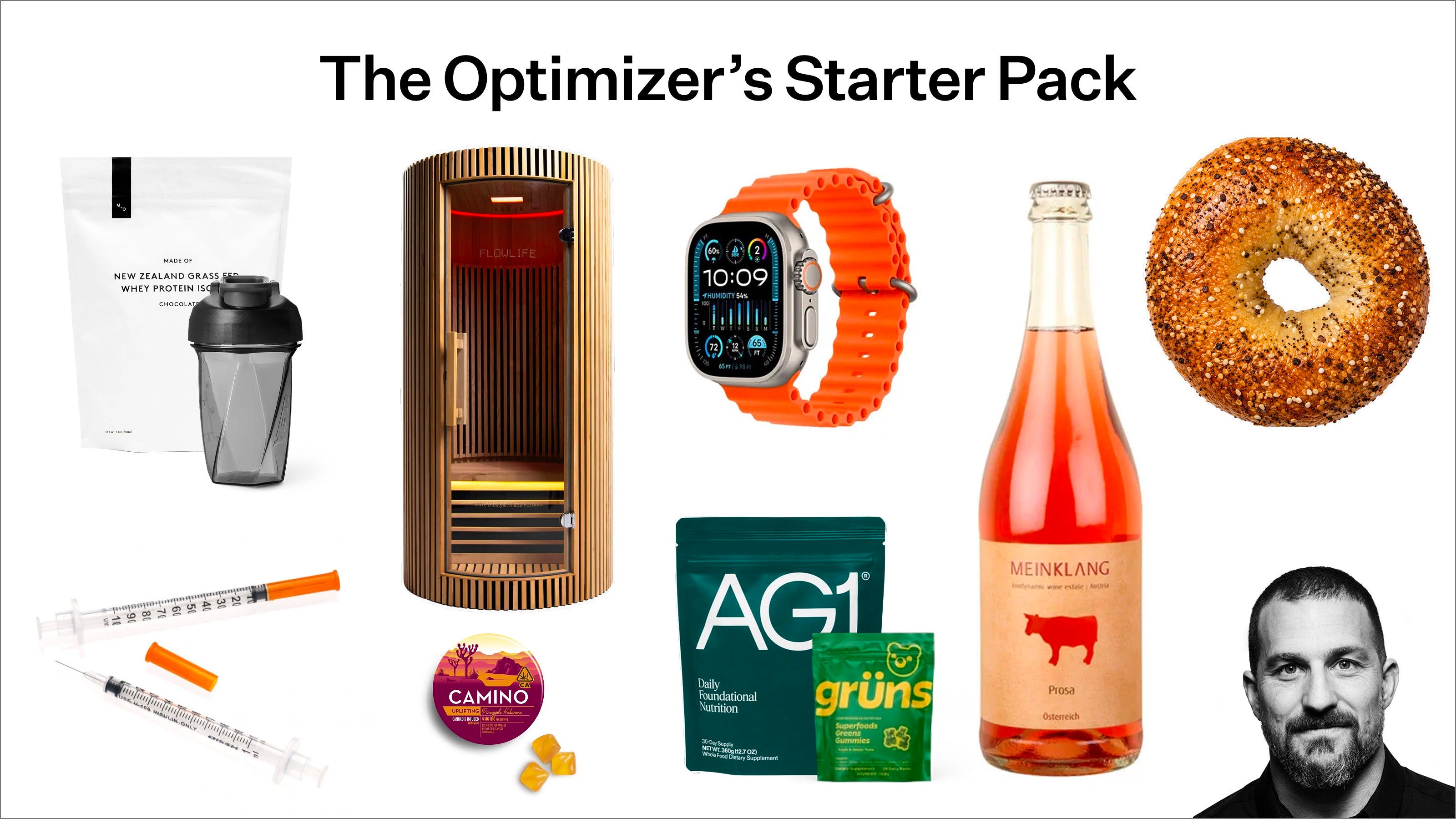
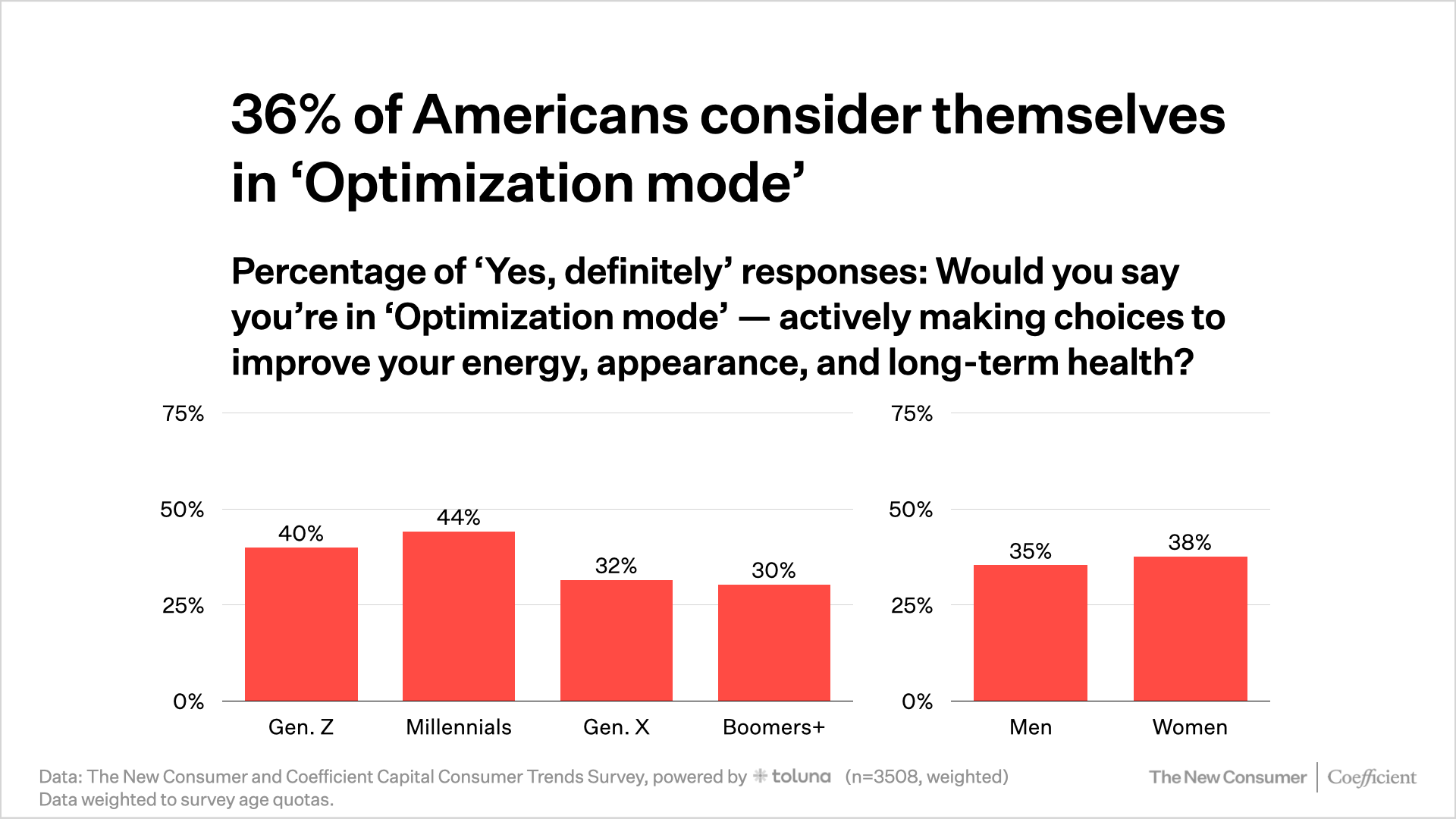
Our Consumer Trends research has identified a consumer group that’s a brand operator’s dream: Around one third of Americans — 36% in our June survey — say they consider themselves in “optimization mode,” actively making choices to improve their energy, appearance, and long-term health.
We’re calling them the Optimizers, and we’ll be following them closely. These people have money, they’re in their spending years, they’re paying attention, and they’re trading up to more premium products and services. As consumer investor Jarret Christie noted on LinkedIn, sharing our latest report, “the ‘Optimizer’ is becoming one of the most important wellness consumers.”
Here are some of the findings from our three latest reports — though primarily from our most recent, the 2026 Mid-Year Report we launched last week — produced in partnership with Coefficient Capital.
Who are the Optimizers?
Optimizers are nearly equally split among men and women, according to our latest Consumer Trends Survey of more than 3,500 US consumers, fielded in June by Toluna. They overindex among Gen. Z (40% consider themselves in optimization mode) and Millennials (44%), people with kids in their household (43%), business owners and founders (46%), remote and hybrid workers (49%), and Black (45%) and Hispanic (40%) consumers.
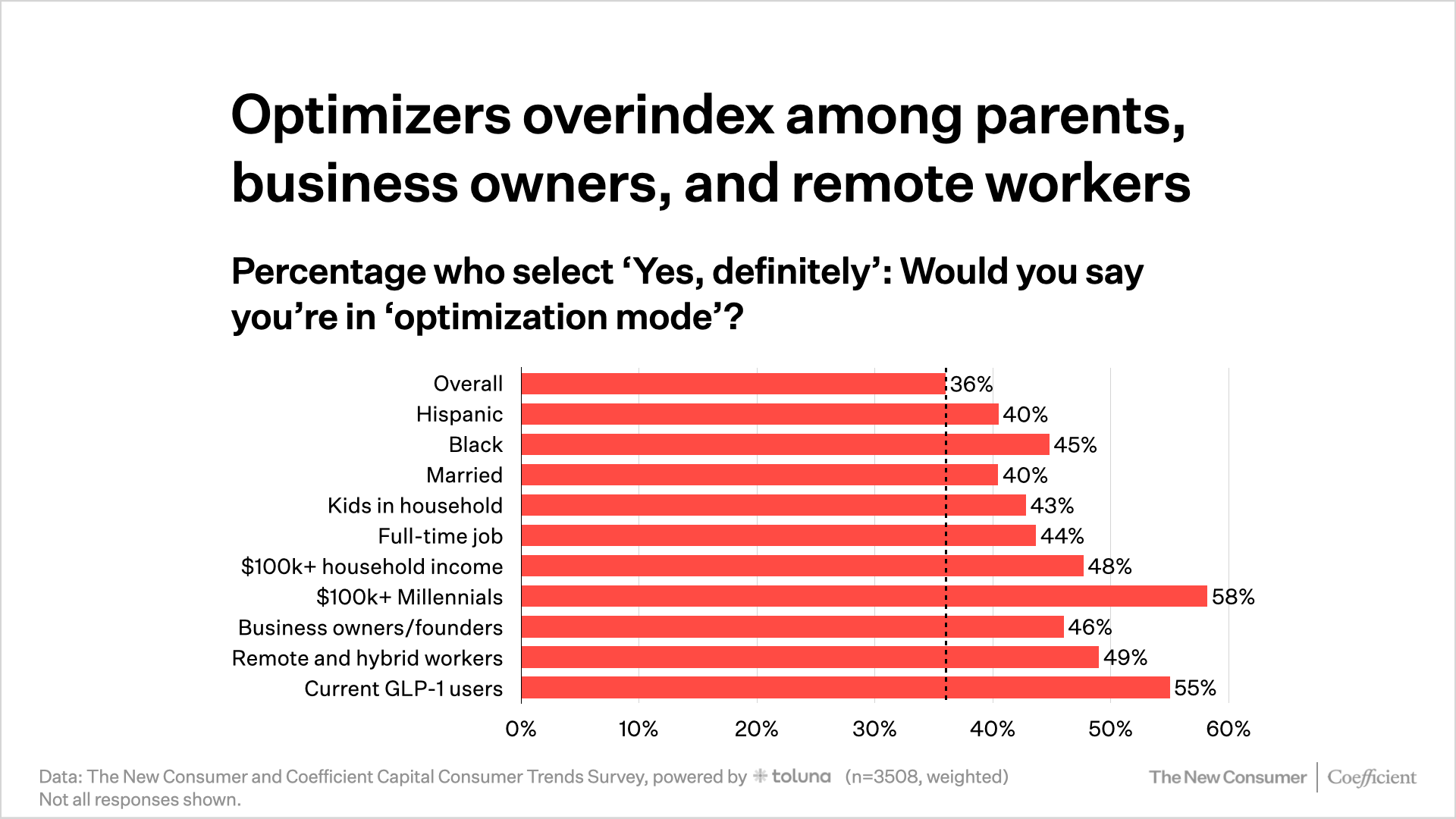
Optimizers overindex among the affluent, but most aren’t rich. Among those with household income under $50k, 33% consider themselves in optimization mode; it’s 44% among those with $100k-$150k income, and 52% among those earning $150k+. Geographically, Optimizer incidence is relatively even, including across urban, suburban, and rural consumers, with less of an urban concentration than you might expect — though it is higher (56%) among high-earning city-dwellers.
How do Optimizers consume?
Optimizers are doing health things and pleasure things at the same time.
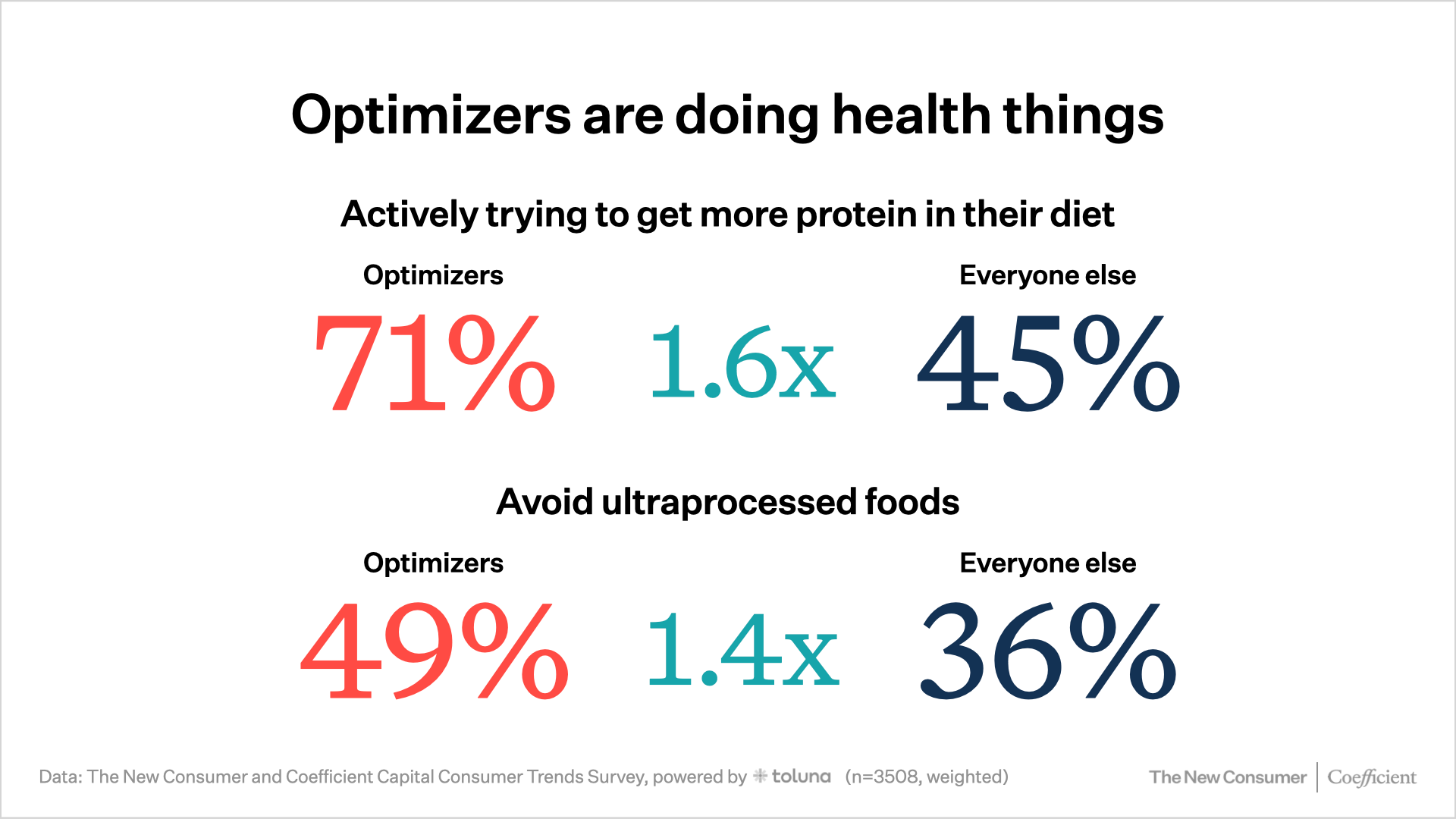
Nearly three quarters of them (71%) say they’re “actively trying to get more protein in their diet,” 1.6x the rate of everyone else (45%). More than half (54%) exercise four or more days a week, vs. 28% of everyone else. They avoid ultra-processed foods (49% say they try to, vs. 36% of everyone else).
Optimizers are nearly twice as likely to say they’ve ever taken a GLP-1 medication like Ozempic or Zepbound (27% vs. 16%). But most aren’t using one — it’s just one tool in the kit. They also love eating: 31% of Optimizers say they “love food more than most people,” as opposed to 17% of everyone else.
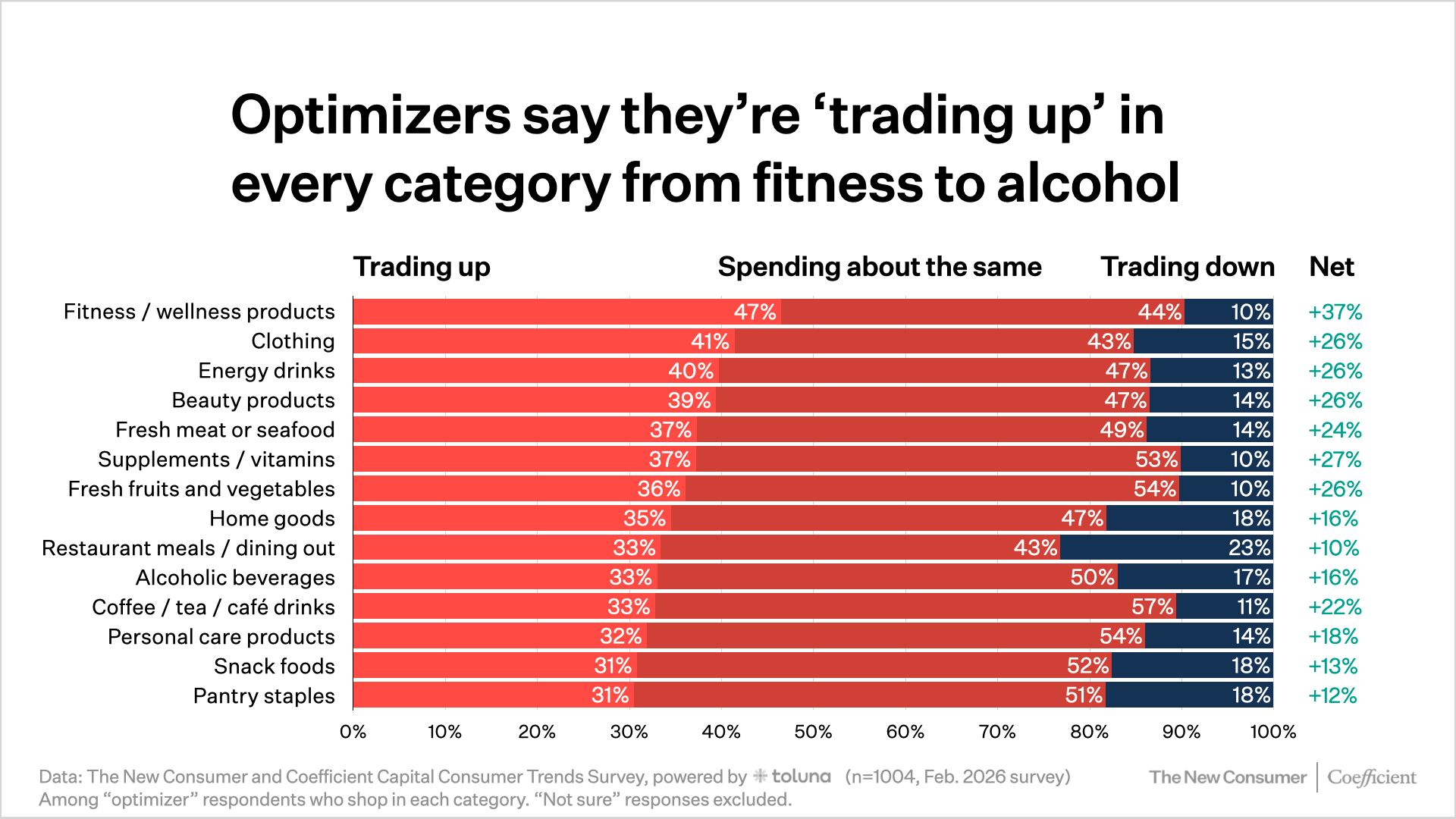
And they’re “trading up” — paying more for the better version — across nearly every consumer category we asked about, led by fitness and wellness products (47% of Optimizers trading up vs. 22% of everyone else), supplements (37% vs. 15%), and beauty (39% vs. 15%).
Optimizers spend on the body: They’re nearly twice as likely (23%) to say they’ve visited a sauna, steam room, or bathhouse in the past year. And 12% said they’ve had a cosmetic procedure, such as Botox or fillers, over the past year — twice the rate of everyone else.
More Optimizers would rather feel ten years younger than look ten years younger, but they choose “look younger” at a higher rate than comparable non-Optimizers.
They’re also relatively heavy drinkers: 29% of Optimizers ages 21+ say they drink alcohol multiple times a week or daily, vs. 22% of everyone else. (One third of 21+ Optimizers who drink say they’re trading up their alcohol, too.) More than a third say they use cannabis more than once a week, 1.7x the rate of everyone else.
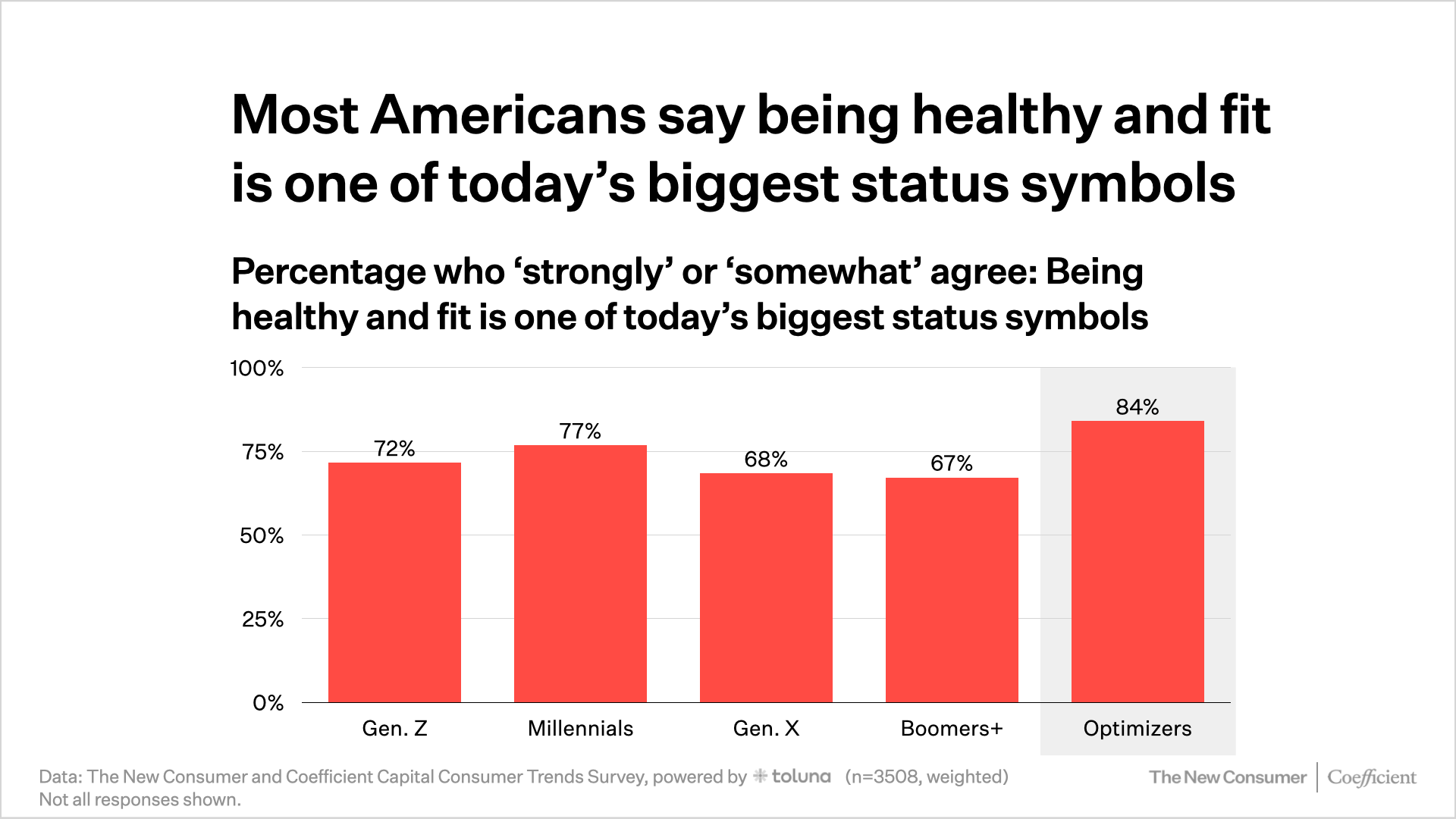
Optimization mode is about enjoying life and using shortcuts as much as it’s about making healthier choices. It’s also a marker of status: asked whether “being healthy and fit is one of today’s biggest status symbols,” 56% of Optimizers strongly agree, versus 21% of everyone else.
Where to find them?
The digital, AI, and creator economies are Optimizer economies.
